Underfloor Cooling

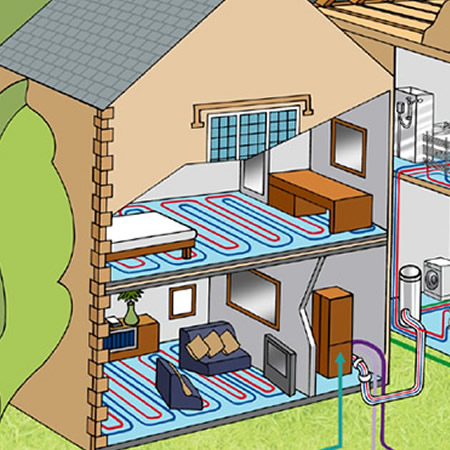
Thermo-Floor underfloor heating systems provide cost effective and energy efficient heating during the winter months but they can also be used to provide underfloor cooling in the summer months.

Our range of products also allows us to provide underfloor cooling all year round if required (for warmer climates) and we can also provide simultaneous underfloor heating and cooling – so one room heating and another room cooling at the same time from the same manifold.


How Does Underfloor Cooling Work

Simultaneous Heating and CoolingAn underfloor cooling system works by the transfer of energy by radiant heat exchange. Radiant heat is when warmth is passed to cooler objects so when the floor is cooled to a temperature cooler than the surrounding air, the floor then absorbs radiant energy proportional to the temperature difference between the surface and the room.  This reduces the radiant air temperature more than the temperature of the floor. By continuing to pass cool water through the floor we are able to keep the floor area cool, which enables us to continually absorb warm air from the room through the floor.


Why Choose Underfloor Cooling

The benefits of underfloor cooling are similar to those of underfloor heating.

It is more cost effective – Thermo-Floor underfloor cooling systems are more cost effective than air conditioning as the outside of the building accumulates less heat therefore reduces heat build up and consequently reduces energy consumption.

It is more comfortable and healthier – Thermo-Floor underfloor cooling systems eliminate drafts, air pollution and dust circulation.

It looks great! – Thermo-Floor underfloor cooling system is out of site and there is no need to unsightly air conditioning units.

It is flexible – Thermo-Floor underfloor cooling system can have different rooms at different temperatures so you can heat and / or cool different rooms at the same time. You choose when you want the heating and / or cooling to be switched on, it does not have to be continuous.

Underfloor Cooling Design & Products

DESIGN

Thermo-Floor underfloor water heating offer a bespoke design service using full colour AutoCAD for each project at no extra cost and can cover everything from preliminary discussions, calculations to final installation by our own trained staff.  A zone drawing indicating the manifold positions, floor sections and pipe layout is provided with an estimate of the total cost of the project.

MANIFOLDS

Manifolds are underfloor cooling distribution units at the centre of the underfloor cooling system.  All the pipes are connected to the manifold and the water flow and return is taken from the manifold back to the energy source of the building.  Below you will find a list of our manifolds with a specification for each one.


SPECIFICATIONS

Self regulating manifold (heating or cooling):

RUV-KThe manifold is used with a water supply temperature of 50°C or greater for heating and pre regulated 18°C for cooling. The manifold is factory pre-assembled, pressure tested to 700kPa and epoxy coated.  The cooling circuit must have a pre-regulated flow to the manifold.  The manifold ranges in size from 2-20 loops.  The pre-assembled manifold comes complete with: welded support brackets, rubber shock absorbers, circulation pump, temperature gauge on return header pressure/temperature gauge on flow header, thermostatic valve complete with temperature probe into flow header, high limit thermostat linked to the primary valve and condensation sensor (which will close the primary cooling circuit should condensation become detected). Each manifold floor loop contains isolation valves for manual electric actuation on the return header and isolation ball valves on the flow header.


Low temperature manifold (heating and cooling):

LTV-KRUW-WThe manifold is used with a pre regulated water supply for both heating and cooling. This low temperature manifold is factory pre-assembled, pressure tested to 700kPa and epoxy coated.  The manifold ranges in size between 2-20 loops.  The pre-assembled manifold comes complete with: welded support brackets, rubber mounting kit, three ball valves on each flow connection, each loop fitted with two preset TS-valves for heating and cooling, one isolating ball valve with flow meter and connections for the heating tube, high limit thermostat, condensation sensor and 24V thermal actuators.


PIPE

Our Polyethylene Pipe is one of the most robust and sturdy available in the UK. However this does not compromise its flexibility, this is a result of over thirty years’ research, development and knowledge.  The pipe has a thick wall diffusion barrier which eliminates corrosion as it is does not allow oxygen to pass from the air through the wall of the pipe.  During production of the pipe an EVOH film (ethylene vinyl alcohol film) is applied to the exterior of the synthetic pipe.  The film has a high diffusion resistance.  This production method provides an optimal bond between the pipe and the EVOH layer ensuring that the tube and the EVOH layer do not separate.  The pipe is “kink” resistant which makes it extremely suitable for all floor and wall heating or cooling.


PIPE SPECIFICATION

16 x 2.7mm and 20 x 3.4mm (KIWA BRL 5601) - This tube is used with a maximum water temperature of 50°C and a pressure up to 6 bar.  In wall heating installation, with a working pressure up to 3 bar, it is possible to increase temperatures up to 55°C.  

16 x 2mm (KIWA BRL 5602) - This is a PE-RT (polyethylene or raised temperature resistance) tube.  The basic is Dowlex 2344; it has been specially developed for use in heating systems.

Thermolink radiator connection system 14 x 2mm and 16 x 2mm - The plastic tube in the Thermolink system has thick walls and is seamlessly extruded.  This PE-RT tube can resist high thermal loads (110°C – 3bar).  This tube has a corrugated sleeve and is available in two colours (to enable the installer to distinguish between supply and return tubes. 


Thermo-Floor Alu-flex tube - is specially designed for underfloor water heating systems and has excellent flexibility and reliability.  It ensures a fast, economical and safe system. Alu-flex has a homogenous welded aluminum core with a 0.4mm wall thickness. This aluminum core is bonded using a special link layer that has a homogenous connection with the aluminum. The combination of aluminum and electrons cross polyethylene combined in one product gives Alu-flex the advantages of the plastic and metal pipes: pressure tight according to DIN 4726 4729 IKP-UNI, 100% oxygen close, an evenly soak low coefficient, flexibility, sound dampening, after bending the tube stays in a solid form, resistance against high pressure and temperature, fully resistance against corrosion even with chemical or electric influences, can be relocated easily with a metal detector, little pressure loss and much more.


FLOOR BUILD UPS

Below are examples of floor build ups that Thermo-Floor underfloor cooling systems can accommodate.

Solid floor screeded:

Tacker Clips - The sub-floor is laid with rigid thermal insulation boards which provide a base on which to fix the underfloor cooling tube. The floor edge is fitted with perimeter insulation which allows for expansion and contraction of the screed.  The pipe work is laid out and securely fastened to the insulation by tacker clips which hold the pipe in the prescribed positions and prevent the pipe lifting or moving during the screeding process. The pipe is connected to the manifold, relevant tests are carried out to ensure system integrity and screed is laid over the top.


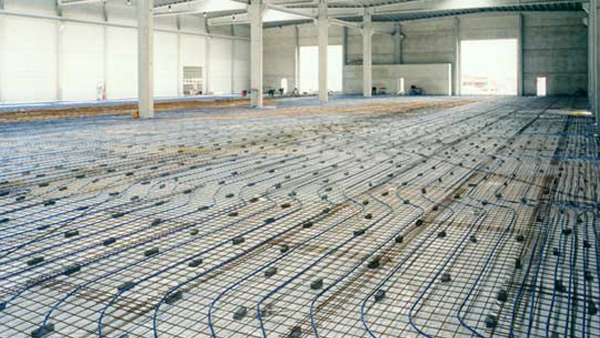
Wire Grid/Mesh -  Generally used when the thermal insulation is installed by others beneath the structural slab or when thermal insulation is not required, this installation method involves attaching pipe to steel mesh which is laid over the concrete slab. The floor edge is fitted with perimeter insulation which allows for expansion and contraction of the screed. Steel mesh of an appropriate grade is laid and fastened to the concrete slab using plastic hammer clips. The pipe work is fastened to the mesh using tie wires which hold the pipe in the prescribed position and prevent the pipe lifting or moving during the screeding process. The pipe is connected to the manifold, relevant tests are carried out to ensure system integrity and screed is laid over the top. The wire grid or mesh system can also be used to cast the pipes directly in the structural slab.


Clip Rail  - The sub-floor is laid with rigid thermal insulation boards which provides a base on which to fix the underfloor cooling tube.  The floor edge is fitted with perimeter insulation which allows for expansion and contraction of the screed. The clip rail panels are laid over insulation and secured with fixing staples.  The pipe is inserted into the clip rail and connected to the manifold, relevant tests are carried out to ensure system integrity and screed is laid over the top.


Castellated Panel - The sub-floor is laid with rigid thermal insulation boards which provides a base on which to fix the underfloor cooling tube. The floor edge is fitted with perimeter insulation which allows for expansion and contraction of the screed.  The castellated panels are laid over the thermal insulation and the pipe is clipped into the panels and connected to the manifold.  Relevant tests are carried out to ensure system integrity and screed is laid over the top.


Structural concrete floors:

Wire Mesh - The hardcore and sand base is laid with rigid thermal insulation boards which rprovide a base on which to fix the underfloor cooling tube. A DPM is laid over the insulation. Steel mesh of an appropriate grade is laid and fastened to the insulation using plastic clips. The pipe work is fastened to the mesh using tie wires which hold the pipe in the prescribed position and prevent the pipe lifting or moving during the concrete pouring process. The pipe is connected to the manifold, relevant tests are carried out to ensure system integrity and concrete is laid over the top. 

NB: Heated screed or concrete floors will expand and contract slightly during use, the edge insulation is normally sufficient to take up this movement.  In some instances and dependent on the desired floor finish (marble, stone, tile) screed expansion joints will be required.


Expansion Joint - Heated screed or concrete floors will expand and contract slightly during use and with a floor finish of tile, marble or stone screed expansion joints will be required.  Thermo-Floor polyethylene pipe is made to withstand this movement however pipes that pass through the movement joint are covered with conduit sleeves as a safety precaution.


Movement Joint -If there is the requirement the underfloor cooling pipework must runacross movement joints in a structural floor slab, a conduit sleeve is fitted to the pipe to allow sufficient movement.


Thermo-Floating Floor - Where there is a requirement of a dry floor finish instead of a screed topping a floating floor system may be used. The floor must be flat and level, pre grooved polystyrene floor insulation panels, fitted with pre grooved aluminum diffuser plates are laid.  The pipe is slotted into these grooved and retained by the plate and connected to the manifold, relevant tests are carried out to ensure system configuration and the dry flooring is laid (chipboard, plywood or dry screed).


Our Guarantee

Relax with a fifty year warranty and watertight guarantee...
Read more >

01455 203 205
  • Twitter
  • Linked In
ConstructionLine CPD Registered Presenter KIWA Approved Product RIBA - CPD providers